
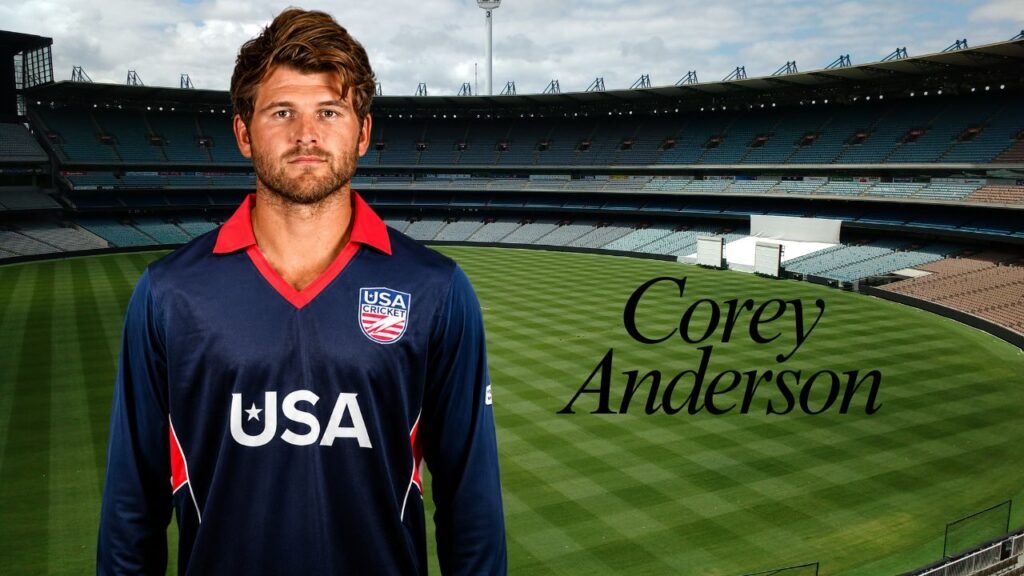
For Corey Anderson, it is a question that has framed a career that never quite followed the path everyone expected. He arrived at the crease in a match at Queenstown on New Year’s Day 2014 and achieved something that no one ever had, reaching an ODI hundred from just 36 balls after dismantling the previous record of Shahid Afridi by almost two years. He was the biggest all-rounder on earth, aged just 23.
Eleven years later, he’s wearing a United States uniform attempting to reinvent himself in a career that was long ago derailed by injury and misfortune.
This is the story of one of cricket most fascinating what-if players.
Player Profile
Anderson turned 35 in December 2025. That number matters because it places him in an unusual phase—old enough to have seen a full career arc, young enough that there’s still cricket ahead. The question is what kind.
The Prodigy Who Couldn’t Stay Healthy
At 16, Anderson was awarded a national contract—making him the youngest player in New Zealand first-class history to do so. He was hurried along the system after already playing for Canterbury. He’d played New Zealand A by 17 and two Under-19 World Cups by 18.
The body was always the problem.
He has struggled with fitness issues from the start. It was 2012 before he scored his first-class hundred—a 167 against Otago, which explained just why everyone got so excited about him in the first place. That innings led to a T20I debut against South Africa, but he failed to make much of an impression, and then injury curtailed his limited-overs opportunities in the following ODI series.
The Day Everything Changed
January 1, 2014. Queenstown, 3rd ODI vs West Indies Match shortened by rain, New Zealand chasing the target with a quickfire
Anderson comes in and absolutely wrecks everything. He got to 100 in 36 balls—one less than Afridi’s record that had stood for 17 years. He ended on 131 not out from 47 balls with an insane number of 14 sixes. His strike rate in that inning is about 280!!
Key Stat: Anderson scored a six every 3.3 balls in that inning. Nobody had ever pulled anything like this off.
The shock wasn’t merely a flash. Anderson scored a century in his second Test—against Bangladesh in October 2013 He was the hottest young thing in New Zealand cricket since Kane Williamson.
The World Cup That Should Have Been More
The 2015 ODI World Cup was Anderson’s time to shine. New Zealand made the final and Anderson played his part too—231 runs and 14 wickets @16.71.
The numbers look decent. They are not the complete story.
And he scored two fifties, including a vital 58 in the semi-final run-chase against South Africa. With the ball, he was effective for most of it. His rhythm was interrupted due to a finger injury while playing IPL 2015 and it repeated several times thereafter.
The Bigger Picture: Anderson was a different cricketer after that World Cup. The injuries accumulated. The consistency never arrived.
The IPL Years
Anderson scored that incredible innings later on earning a $750,000 place with Mumbai Indians. One of the great innings of the tournament: 95 off 44 against Rajasthan Royals — chasing 190 in 14.3 overs to make it through the playoffs, IPL 2014.
The knock is still regarded as legendary among Mumbai Indians fans. Transferring from No. 3, Anderson went out and stole the game.
IPL Stats: 30 games, 538 runs at 24.45, strike rate of 127.19, and 11 wickets.
The returns diminished after that. The next couple of seasons saw him represent Delhi Daredevils in 2017 and Royal Challengers Bangalore in 2018. Injuries limited his availability. The Mumbai Indians moved on.
The Injury That Kept Coming
This is the part of Anderson’s career that’s hardest to write.
Stress fractures. Groin injuries. Chronic back issues. A spate of finger fractures. Each time he looked ready to rebuild, something broke.
What It Meant: Anderson has not played a Test since 2016. His last ODI was in 2017. The last time he played a T20I for New Zealand was November 2018. He was still only 27.
“I would have loved to have achieved and played more,” he later said, “but just is what it is sometimes, and different opportunities arise.”
Career Statistics
Let’s Understand What the Numbers Really Indicate: The test average (32.52) is reasonable for a batting all-rounder. His ODI strike-rate of 108.72 is terrific for the time he played in. But the volume—49 ODIs, 13 Tests—is the real story. That’s not the career of a player who was consistently available.
Read More: Andries Gous: Profile, Stats & Record-Breaking Career
Career Timeline
The Move to America
Anderson relocated to Texas in 2020. His fiancée, Mary Margaret, is American. The decision was personal as much as professional.
“Obviously, I believed that living in America is the best thing, not only for my cricket but also for both of us to live; it was our way of life,” he said.
He penned a three-year contract to play with Major League Cricket (MLC). The contract asked him to play major and minor league cricket and provide coaching services. Under the four-year residency rule, he gained USA selection in 2023.
Timing: Anderson hasn’t played for New Zealand since 2018. As of 2022, he was then free to make the switch under the ICC’s four-year rule. The US national team added someone with World Cup experience.
San Francisco Unicorns: Captaincy and Collapse
In MLC, Anderson was captain of San Francisco Unicorns.
The 2024 season was underwhelming. The 2025 season was worse. His campaign was cut short when Anderson had to stop following three innings due to injury, having scored just 12 runs.
The Unicorns cut ties with their captain in March 2026. Cricbuzz reported that the “move felt increasingly inevitable.”
Why This Is Important: Out of the Unicorns’ three domestic players, Anderson was the most expensive at $75,000 per year.The franchise decided to reset. Anderson moved on.
2026: A New Start with MI New York
The 2026 MLC season has brought Anderson back into the spotlight.
He’s displayed glimpses of the former brilliance for MI New York. In the run chase of 165 against Los Angeles Knight Riders, he also scored a terrific 37 runs not out off 24 balls along with Kieron Pollard to put up an outstanding partnership of 89 for the loss of no wicket.
Why It Matters: The fact that Anderson has teamed with Pollard—two veterans of the game still playing at a high level. The question is whether he can sustain it.
USA National Team: The World Cup Experience
Anderson has become a key figure for USA cricket. And he was there to help his team into the Super Eights of the 2026 T20 World Cup—a first for American cricket
After a Super Eight defeat to England, Anderson fronted the media: “Making it through to the Super Eights was obviously a historic occasion for the USA”.
The Bigger Picture: Anderson’s World Cup experience—he played in a final with New Zealand—is invaluable for a developing USA team. He’s one of the few players in the squad who’s been on the biggest stage.
The Contract Dispute
Off the field, Anderson has become a voice for players’ rights.
In September 2025, USA Cricket terminated its contract with American Cricket Enterprises (ACE), which manages MLC operations. The dispute centered on alleged unpaid dues—ACE was contracted to provide at least $1.2 million annually for national team contracts.
Anderson, serving as operational director of the US Cricketers’ Association, spoke out: “The sudden termination of the contract between USA Cricket and ACE has left players uncertain about their professional futures.”
Why It Matters: Anderson isn’t just a player anymore. He’s helping shape the infrastructure of American cricket.
Playing Style: Power and Potential
Anderson is a left-handed batsman who clears the rope with brutal efficiency. His 36-ball century featured 14 sixes. At his best, he’s one of the most destructive hitters in the game.
Strengths:
- Raw power through the line
- Ability to accelerate instantly
- Left-arm medium-fast bowling adds balance
- Experience across global T20 leagues
Weaknesses:
- Inconsistency
- Injury history
- Technical vulnerabilities against high pace
What Makes Anderson Different: He doesn’t just hit sixes—he hits them with a force that few players can match. His burly physique and clean swing make him look like he belongs in the All Blacks’ front row. When he connects, the ball stays connected.
Read More: Monank Patel: The Gujarat-Born Captain Writing American Cricket History
What the Numbers Say About His Game
Anderson’s T20 strike rate of 138.36 is excellent. His List A strike rate of 99.79 is strong for an all-rounder.
But here’s the number that matters most: 152 T20 matches across his career. For a player who debuted in 2007, that’s not many. The injuries didn’t just affect his performance—they affected his opportunities.
The Takeaway: Anderson’s numbers suggest a player who could have achieved far more with better health. The raw ability was never the issue.
Where Anderson Stands Now
At 35, Anderson is no longer the young prodigy. But he’s still playing, still contributing, still finding ways to matter.
The Current Picture:
- Playing for MI New York in MLC 2026
- Representing USA in international cricket
- Serving as a player representative in contract disputes
- Providing experience to a developing American program
What Comes Next
Anderson has two or three seasons of high-level cricket left. The next T20 World Cup in 2026 is a realistic target. After that, coaching or administration seems likely—he’s already shown aptitude for leadership.
One Plausible Outcome: Anderson continues with USA cricket through the 2026 T20 World Cup, then transitions into a coaching or administrative role with MLC or USA Cricket.
Another: He finds one more purple patch with MI New York, reminds everyone what he can do, and extends his playing career another year or two.
The Legacy Question
Corey Anderson will always be remembered for one thing: the 36-ball century. That record stood briefly—AB de Villiers broke it later in 2014—but the moment itself was unforgettable.
What Defines His Career:
- The youngest New Zealander to earn a national contract
- The fastest ODI century in history (briefly)
- A World Cup finalist
- A player who never quite fulfilled his potential due to injury
What Remains to Prove: That he can still perform at the highest level. That the injuries are behind him. That the USA chapter can be more than a retirement tour.
The Myth to Correct
Myth: Corey Anderson was a flash in the pan.
Reality: Anderson’s career was derailed by injuries, not lack of talent. His Test average of 32.52, ODI strike rate of 108.72, and 14 wickets at the 2015 World Cup prove he was a genuine all-rounder at the highest level. The volume wasn’t there, but the quality was.
Editorial Observation
The most overlooked part of Anderson’s game is his bowling. In the 2015 World Cup, he took 14 wickets at 16.71—better than his batting average in the tournament. For a player known for his hitting, his left-arm medium pace was often the difference between being a bits-and-pieces player and a genuine all-rounder.
Professional Observation: Anderson’s batting average (27.72 in ODIs) doesn’t fully capture his value. His strike rate (108.72) does. He was a player who changed games in 20-minute bursts, not through accumulation. That’s a rare and valuable skill.
What Fans Should Watch Next
Watch Anderson in the 2026 MLC playoffs. If MI New York goes deep, he’ll have opportunities to produce the kind of innings that made his reputation. Watch how he handles high pace—that’s always been the vulnerability. Watch whether he can stay healthy for a full season.
The story isn’t over. It’s just in a different country.
FEATURED SNIPPET ANSWERS
Who is Corey Anderson?
Corey Anderson is a New Zealand-born American cricketer who plays as a left-handed batting all-rounder. He holds the record for the fastest ODI century in cricket history, reaching 100 off just 36 balls against West Indies in 2014. He now represents the United States national team.
How old is Corey Anderson?
Corey Anderson was born on December 13, 1990, making him 35 years old as of 2026. He was born in Christchurch, Canterbury, New Zealand.
What team does Corey Anderson play for?
Corey Anderson currently plays for the United States national cricket team and MI New York in Major League Cricket. He previously played for New Zealand internationally and numerous IPL and T20 franchises including Mumbai Indians and Royal Challengers Bangalore.
How much does Corey Anderson earn?
Corey Anderson earned $75,000 per season as a domestic player for San Francisco Unicorns in MLC. He previously signed a three-year contract with Major League Cricket after his New Zealand retirement, and earned $750,000 from Mumbai Indians in the IPL.
What are Corey Anderson’s career statistics?
Corey Anderson’s career stats include 683 Test runs at 32.52, 1,109 ODI runs at 27.72 with a strike rate of 108.72, and 2,770 T20 runs at 25.41 with a strike rate of 138.36. He took 16 Test wickets and 60 ODI wickets.
FAQs
1. What happened to Corey Anderson in cricket?
2. Has Corey Anderson retired from cricket?
3. Why is Corey Anderson not playing IPL?
A: Anderson hasn’t played in the IPL since 2018. Injuries reduced his availability and effectiveness, and franchises moved on to other options. He now focuses on Major League Cricket in the USA and international cricket with the US national team.
4. Who is Corey Anderson?
5. How many wickets did Corey Anderson take in the 2015 World Cup?
6. What is Corey Anderson’s highest ODI score?
A: Anderson’s highest ODI score is 131 not out, which he scored against West Indies in Queenstown on January 1, 2014. He reached his century in just 36 balls, setting a new world record for the fastest ODI hundred at the time.
7. Why did Corey Anderson leave New Zealand cricket?