
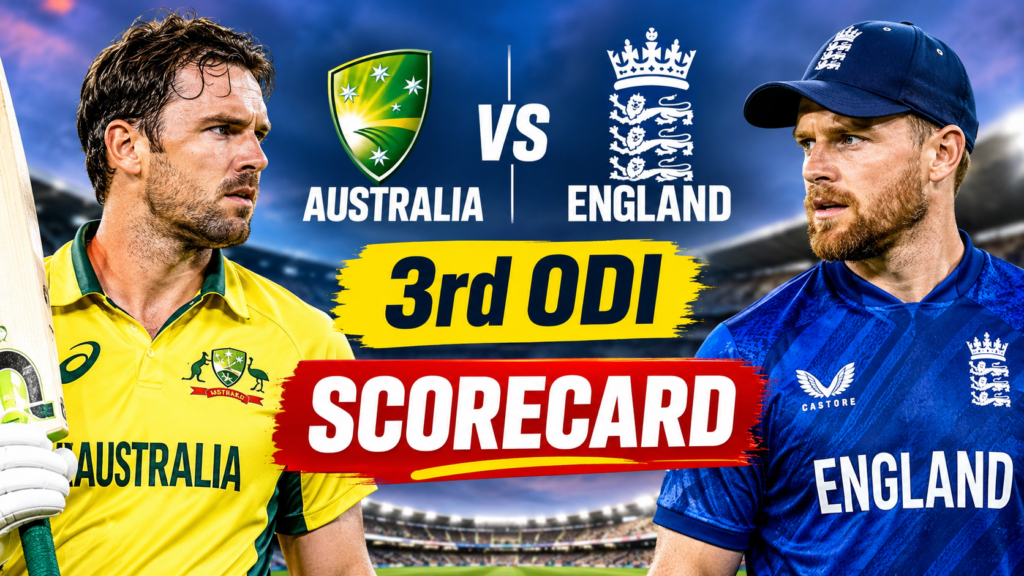
Australia vs England 3rd ODI Scorecard Australia’s chase is not collapsing in the conventional sense—there has been no cluster of wickets in a single dramatic over. What is happening is more subtle and, for Australia, more damning: a slow, structural bleed of tempo that began in the first ten balls and has never been corrected.
Australia needed 6.58 and was over at the start. By the end of the 27th over, the required rate had passed nine. By the 41st, it sits at 13.44. The chase was not lost in a single moment. It was lost in the accumulation of moments where Australia chose stabilization over acceleration, and England’s bowlers—particularly Liam Dawson and Sonny Baker—made that choice feel like a trap.
One-line verdict: This was a 329 chase lost in the middle overs, not the death overs. Australia’s third-wicket partnership stabilized the innings and buried the chase in the same 95 balls.
Match Information and Toss
| Detail | Information |
|---|---|
| Match | Australia vs England, 3rd ODI |
| Series | England tour of Australia, 2026 (series decider, 1-1) |
| Venue | Bellerive Oval, Hobart |
| Toss | England won the toss and elected to bat |
| Umpires | Sharfuddoula Saikat, Shaun Haig; 3rd Umpire: Chris Gaffaney; Referee: Javagal Srinath |
Selection context: Australia left Adam Zampa out with back spasms and brought in Alex Carey as a specialist batter. That decision reshaped Australia’s bowling attack: without their premier leg-spinner, the spin load fell to Matt Renshaw (offspin), Cooper Connolly (left-arm), and Travis Head (part-time). England, meanwhile, picked Liam Dawson and gave him a long spell. By the middle of Australia’s chase, that selection difference looked less like rotation and more like the tactical hinge of the match.
England Innings: 328 All Out (48.3 Overs)
Batting Scorecard
| Batter | Dismissal | R | B | 4s | 6s | SR |
|---|---|---|---|---|---|---|
| Tom Banton | c Mitchell Marsh b Jack Edwards | 44 | 35 | 9 | 0 | 125.71 |
| Ben Duckett | c Josh Inglis b Matt Renshaw | 133 | 115 | 15 | 3 | 115.65 |
| Joe Root | b Matt Renshaw | 12 | 15 | 1 | 0 | 80.00 |
| Harry Brook (c) | c Mahli Beardman b Cooper Connolly | 17 | 23 | 2 | 0 | 73.91 |
| Jordan Cox (wk) | st Josh Inglis b Matt Renshaw | 12 | 23 | 0 | 0 | 52.17 |
| Jofra Archer | c Jack Edwards b Travis Head | 7 | 7 | 1 | 0 | 100.00 |
| Will Jacks | c Mahli Beardman b Jack Edwards | 59 | 48 | 4 | 1 | 122.92 |
| Sam Curran | c (sub) Liam Scott b Jack Edwards | 19 | 16 | 2 | 0 | 118.75 |
| Gus Atkinson | b Xavier Bartlett | 10 | 6 | 0 | 1 | 166.67 |
| Liam Dawson | c Cameron Green b Jack Edwards | 3 | 3 | 0 | 0 | 100.00 |
| Sonny Baker | not out | 0 | 1 | 0 | 0 | 0.00 |
Extras: 12 (b 1, lb 3, w 7, nb 1)
Total: 328-10 (48.3 Ov, RR 6.76)
Read Also: Pakistan National Cricket Team vs Afghanistan National Cricket Team Timeline
Bowling: Australia
| Bowler | O | M | R | W | Econ |
|---|---|---|---|---|---|
| Xavier Bartlett | 7 | 0 | 66 | 1 | 9.40 |
| Spencer Johnson | 6 | 0 | 45 | 0 | 7.50 |
| Mahli Beardman | 8 | 0 | 54 | 0 | 6.80 |
| Jack Edwards | 5.3 | 0 | 31 | 4 | 5.60 |
| Matt Renshaw | 10 | 0 | 51 | 3 | 5.10 |
| Cooper Connolly | 8 | 0 | 44 | 1 | 5.50 |
| Travis Head | 4 | 0 | 33 | 1 | 8.20 |
Fall of wickets: 74-1 (Banton, 8.4), 112-2 (Root, 14.4), 146-3 (Brook, 22.2), 172-4 (Cox, 29.0), 195-5 (Archer, 32.1), 251-6 (Duckett, 39.0), 292-7 (Curran, 44.4), 307-8 (Atkinson, 46.0), 312-9 (Dawson, 46.5), 328-10 (Jacks, 48.3)
Powerplay (0.1–10): 79 runs
Australia Innings: 208-9 (41 Overs, Match in Progress)
Batting Scorecard (at time of writing)
| Batter | Dismissal | R | B | 4s | 6s | SR |
|---|---|---|---|---|---|---|
| Travis Head | c Joe Root b Gus Atkinson | 4 | 3 | 1 | 0 | 133.33 |
| Mitchell Marsh (c) | c Harry Brook b Sonny Baker | 1 | 5 | 0 | 0 | 20.00 |
| Matt Renshaw | c and b Liam Dawson | 55 | 70 | 6 | 0 | 78.57 |
| Josh Inglis (wk) | c Jordan Cox b Sonny Baker | 14 | 18 | 1 | 0 | 77.78 |
| Alex Carey | run out (Ben Duckett/Jordan Cox) | 37 | 53 | 2 | 0 | 69.81 |
| Cameron Green | retd hurt | 3 | 11 | 0 | 0 | 27.27 |
| Cooper Connolly | b Liam Dawson | 29 | 25 | 2 | 1 | 116.00 |
| Jack Edwards | c Gus Atkinson b Liam Dawson | 31 | 36 | 2 | 0 | 86.11 |
| Oliver Peake | c Liam Dawson b Sonny Baker | 5 | 6 | 0 | 0 | 83.33 |
| Xavier Bartlett | Harry Brook and Sonny Baker | 16 | 8 | 2 | 1 | 200.00 |
| Spencer Johnson | batting | 5 | 4 | 1 | 0 | 125.00 |
| Mahli Beardman | batting | 3 | 7 | 0 | 0 | 42.86 |
Extras: 5 (w 5)
Total: 208-9 (41 Ov, RR 5.07)
Required rate: 13.44
Bowling: England
| Bowler | O | M | R | W | Econ |
|---|---|---|---|---|---|
| Gus Atkinson | 8 | 0 | 39 | 1 | 4.90 |
| Sonny Baker | 8 | 1 | 42 | 4 | 5.20 |
| Will Jacks | 4 | 0 | 17 | 0 | 4.20 |
| Jofra Archer | 7 | 0 | 41 | 0 | 5.90 |
| Sam Curran | 2 | 0 | 15 | 0 | 7.50 |
| Joe Root | 3 | 0 | 20 | 0 | 6.70 |
| Liam Dawson | 9 | 0 | 34 | 3 | 3.80 |
Fall of wickets: 5-1 (Head, 0.4), 5-2 (Marsh, 1.4), 34-3 (Inglis, 7.3), 108-4 (Renshaw, 23.2), 115-5 (Carey, 26.1), 162-6 (Connolly, 33.6), 179-7 (Peake, 36.4), 199-8 (Bartlett, 38.5), 203-9 (Edwards, 39.2)
Powerplay (0.1–10): 47 runs
Verified context: Cameron Green retired hurt on 3 off 11 after being struck in the grill of his helmet by a Gus Atkinson bouncer, bleeding from the mouth. Oliver Peake entered as the concussion substitute.
Ben Duckett’s 133: The Innings That Built the Total
Duckett’s seventh ODI hundred was not a slog. It was a structural innings on a surface that ESPNcricinfo described as “”sedate”—lacking the pace and bounce that makes Bellerive a batting paradise. Duckett’s value was not just the 133 runs; it was the 115 balls he consumed, allowing England to survive a middle-order wobble that saw them slip from 112-1 to 195-5.
His partnership with Tom Banton (44 off 35) set the platform: England raced to 74-1 in 8.4 overs, with Banton taking nine boundaries in a 35-ball cameo. When Banton fell to a stunning running catch from Mitchell Marsh, Duckett absorbed the pressure. When Harry Brook, Joe Root, and Jordan Cox fell in a cluster, Duckett was still there. When he finally top-edged a Renshaw delivery to Inglis at 251-6 in the 39th over, England were already on course for a total above par.
The death overs were the difference between a good score and a winning one. Will Jacks (59 off 48) and Sam Curran (19 off 16) added 77 runs in the last 9.3 overs, turning 251-6 into 328 all out. Australia’s death bowling was not catastrophic—Jack Edwards finished with 4-31—but the specialist quicks leaked: Xavier Bartlett at 9.40 and an over, and Spencer Johnson at 7.50.
Why Australia’s Chase Is Unravelling
The First Ten Balls Reframed Everything
Australia needed 6.58 and over. Ten balls later, they were 5-2.
Travis Head edged Gus Atkinson to Joe Root at 5-1 in the first over. Mitchell Marsh followed in the next over, caught by Harry Brook off Sonny Baker for 1 off 5. Two of Australia’s three most destructive top-order players were gone inside 1.4 overs, and the innings shifted from “chase” to “rebuild” before a partnership had even formed.
This is the hidden turning point. At 5-2, the required run rate was still 6.64—mathematically almost identical to the starting rate. But the mindset changed. Australia stopped attacking. They started stabilizing. And in a 329 chase, stabilization is a trap dressed as discipline.
The Third-Wicket Partnership: Stabilization and Its Cost
Matt Renshaw and Alex Carey did what good players do after a top-order collapse: they rebuilt. Their third-wicket partnership of 74 runs took 95 balls. That is 4.67 runs per over across the most important phase of the innings.
In isolation, it was not bad cricket. Renshaw reached his fifty off 58 balls. Carey rotated the strike. The score moved from 34-3 to 108-4 without further loss. But the required rate climbed from 6.58 to 8.29 by the time Renshaw fell to Liam Dawson at 108-4 in the 23rd over and to 8.98 by the time Carey was run out at 115-5 in the 27th. The partnership did its job in stabilizing the innings. It failed in the only job that mattered: keeping the chase within reach.
Read Also: West Indies Cricket Team vs India National Cricket Team Timeline
Dawson’s Squeeze and the Collapse That Followed
Liam Dawson’s 9-0-34-3 was the most consequential spell of the match. His left-arm spin took the pace off the ball exactly when Australia needed to accelerate. He broke the Renshaw-Carey stand, bowled Cooper Connolly at 162-6, and returned to dismiss Jack Edwards at 203-9. His economy of 3.80 across nine overs in a match where the required rate was climbing past eight was the tactical equivalent of a slow puncture.
Sonny Baker (4-42) bookended the innings with the new ball and the old, removing Marsh and Inglis early before returning to dismiss Peake and Bartlett late. Gus Atkinson (8-0-39-1) gave Harry Brook control at the top. England’s bowling plan was built on one principle: make Australia score at eight-plus against spin and back-of-hand pace, or not at all. Australia could not.
Player Performance Analysis
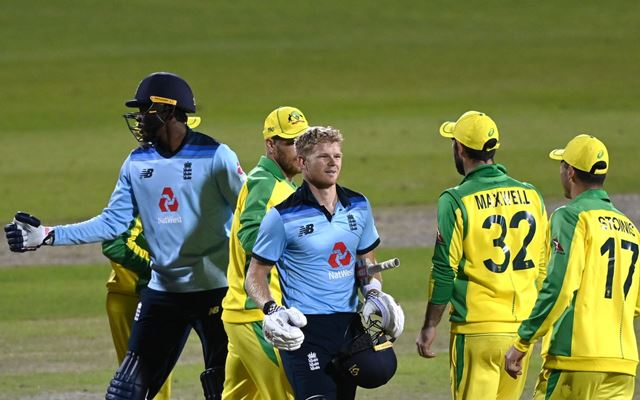
Ben Duckett—133 off 115 (9/10). The innings that made 328 possible. Risk factor: low. He never let the strike rate balloon into recklessness, and his dismissal at 251-6 came after the platform was already set.
Jack Edwards—4-31 off 5.3 overs (8.5/10). The best bowling figures on either side, and the most improbable. Edwards is not Australia’s frontline enforcer; he is the bowler England would have targeted. Instead, he broke England’s lower order at the death. His 31 off 36 with the bat was less helpful—exactly the kind of responsible-looking innings that costs a chase.
Sonny Baker—4-42 off 8 overs (8/10). Two early wickets, two late ones. Baker’s new-ball spell reduced Australia to 5-2 and set the tone. His economy (5.20) was helped by Australia’s caution, but the wicket-taking threat was real throughout.
Liam Dawson — 9-0-34-3 (8.5/10). England’s best tactical selection. No headlines, no express pace. Just nine overs of control that made the required rate feel like a wall.
The underperformer: Alex Carey—37 off 53 (SR 69.81) (4/10). In a chase requiring 6.6 an over, a senior wicketkeeper-batter scoring at under 70 for 53 balls is not anchoring; it is absorbing pressure without releasing it. His run-out at 115-5 was self-inflicted—a communication breakdown with Cameron Green that David Warner called “disgraceful running between the wickets.” The innings before the run-out was the deeper issue.
The underrated contributor: Matt Renshaw — 55 off 70 (7/10). Renshaw’s fifty was necessary and costly in equal measure. He held the innings together when it could have fallen apart at 34-3. But his 70-ball duration in a 329 chase was the tempo problem in miniature. Both things are true.
Series Impact
This is the series decider. England, having levelled the series at 1-1 with a 135-run win at Adelaide, are on the verge of a rare ODI series win in Australia. For Australia, the questions are structural rather than mathematical. The middle-order tempo problem — the inability to shift from stabilisation to acceleration — is not a one-match issue. It is a pattern that has followed this batting line-up through the series. Zampa’s absence exposed the bowling depth. Green’s injury exposed the batting depth. The scorecard will show a chase that fell short. The tape will show a chase that was never given the tempo to succeed.
FAQs: Australia vs England 3rd ODI Scorecard
1. Who was the best player in Australia vs England 3rd ODI?
A: Ben Duckett, for the structural value of his 133 off 115. Liam Dawson’s 3-34 was the most tactically significant spell.
2. What was the turning point?
A: Australia slipping to 5-2 after 1.4 overs. It reframed the chase from aggressive to cautious, and the required rate never stopped climbing.
3. Why is Australia losing the chase?
A: Slow middle-over scoring. The third-wicket partnership of Renshaw and Carey consumed 95 balls for 74 runs in a chase requiring 6.6 an over.
4. Which tactical move mattered most?
A: England giving Liam Dawson nine overs of spin through the middle. It choked Australia’s rebuild at exactly the right phase.
5. Was 328 a par score?
A: No. On a sedate Bellerive surface, 328 was above par. Australia’s approach suggested they misread it as a par total, and that misread was decisive.
6. What happens next?
A: England should close out the series. The bigger question is whether Australia’s middle order can find a second gear in the remaining fixtures.
Conclusion
This was not a match decided by a single heroic spell or a dramatic collapse. It was decided by tempo — England’s willingness to attack in two distinct phases, and Australia’s inability to attack in any phase until the game was gone.
The biggest tactical lesson is uncomfortable for Australia: rebuilding is not the same as chasing. A 74-run partnership in a 329 chase can be both necessary and fatal, and the scorecard will never tell you which. The tape will.
England’s 328 was built on Duckett’s platform and Jacks’ death-over surge. Australia’s response was built on a stabilisation that never became acceleration. The result, when it is confirmed, will flatter Australia slightly. The analysis should not.