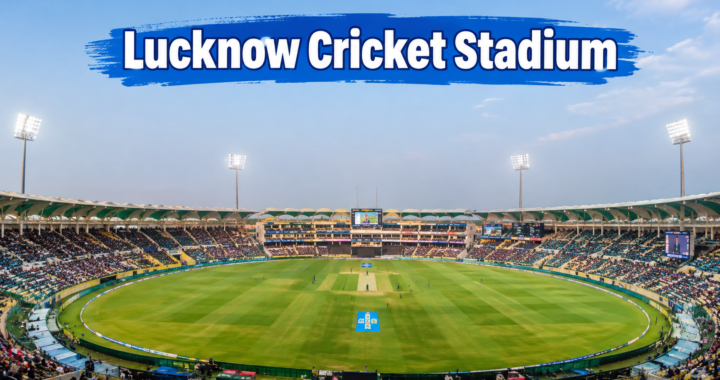

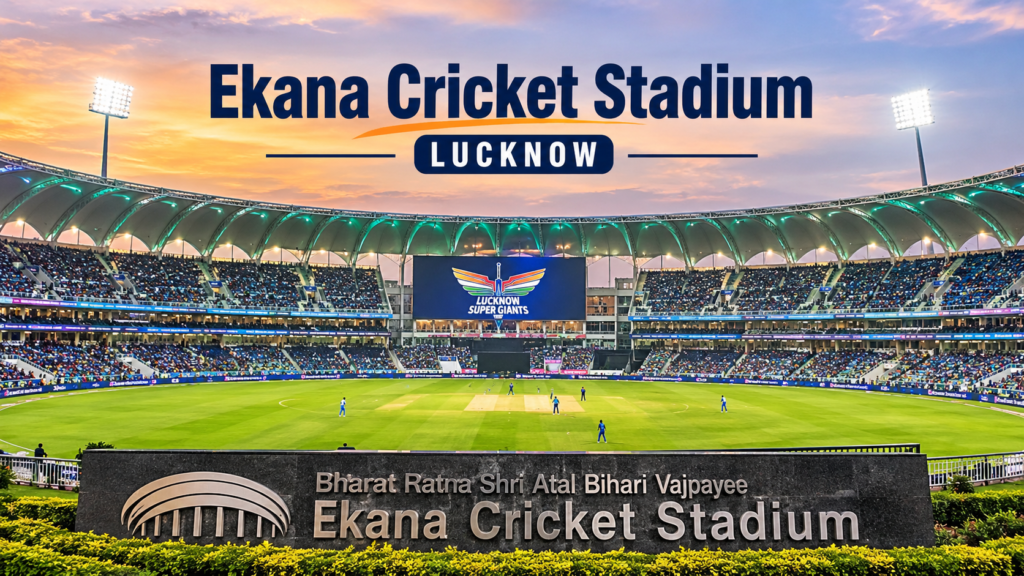
The Ekana Cricket Stadium in Lucknow is one of the more structurally interesting venues on the Indian circuit precisely because the market has settled on a narrative that the underlying data does not fully support. The surface is not slow in one direction. It is conditionally slow, and the conditions change based on which strip is used, which format is being played, and which season you are sampling.
This is a read for people who care about the difference between a venue’s reputation and its behavior.
The First Contrarian Read: “Slow Pitch” Is a Sample-Size Illusion
The dominant narrative is that Ekana is a bowler’s ground. And there is evidence for it.
In the IPL, the venue has produced genuine low-scoring thrillers. Of the six games at Ekana in IPL 2026, four were low-scoring contests where batters struggled with timing. The boundaries are long—averaging over 75 meters on all sides—which suppresses six-hitting and forces batters to run harder for twos. Zaheer Khan, as LSG’s bowling coach, publicly expressed frustration with the home pitch after a heavy defeat, a signal that even the home franchise has not fully solved the surface.
But here is the part the surface-level reports miss: the IPL average at Ekana is not low. An average first-innings score of 174 is not a “low-scoring ground” in the 2020s IPL context. It is a par venue with a wide variance band. The ground does not suppress scoring in aggregate. It suppresses certain kinds of scoring—predictable, rhythm-based batting—while allowing explosive individual innings when a batter reads the surface correctly.
Shreyas Iyer’s 102* off 43 balls in a chase at Ekana in October 2026 is the cleanest proof. The same venue that produces 120-all-out collapses also produces 200-plus chases completed inside 15 overs. A venue that does both is not a “bowling pitch.” It is a high-dispersion venue, and dispersion is a pricing problem, not a pitch-type problem.
The Ownership Layer Nobody Connects to Performance
Ekana is not a BCCI-owned ground. It is not a state-association ground in the traditional sense. It is a PPP asset—a Special Purpose Vehicle owned by Ekana Sportz City Pvt. Ltd., a consortium of Nagarjuna Construction Company (NCC) and GCC Pvt. Ltd., operating under a 35-year concession that expires in 2052.
Why does this matter for pitch behavior?
Because a PPP operator has a different incentive structure than a cricket board. The operator’s revenue comes from events, leasing, and the broader Ekana Sportz City real estate ecosystem—not solely from producing a “fair” cricket surface. The Uttar Pradesh Cricket Association (UPCA) has a profit-sharing agreement with the venue’s management, not operational control.
This does not mean the pitch is manipulated. It means the surface is managed within a commercial ecosystem that prioritizes event viability over surface consistency. A venue that needs to host IPL matches, international fixtures, women’s tournaments, and non-cricket events has a harder time maintaining a single, stable playing character across strips.
That is the structural reason Ekana behaves like two grounds. The black-soil strips are the “slow” Ekana. The red-soil strips are the “bouncy” Ekana. The label conflates them.
The Data That Actually Matters (and the Data That Misleads)
Here is the honest state of the numbers as of late 2026.
In T20 Internationals, Ekana has produced scores ranging from 99 to 199 across six completed matches. The average first-innings score is around 151, and the average second-innings score is around 126. That second-innings number is the one to underline. A venue where the chasing average is 25 runs below the first-innings average is a venue where the surface deteriorates materially—and where toss becomes a genuine variable, not a ritual.
In the IPL, the sample is larger and the scoring is higher. Across 28 matches, the average first-innings score is 174. The highest team total is 235, and the highest successful chase is 206. Teams batting first have won 12; teams batting second have won 15, with one no-result. That win split—12–15—is not a decisive “bowl first” signal. It is a near-neutral venue with a slight chasing edge, which is the IPL norm, not an Ekana-specific anomaly.
The ODI sample is the most revealing of all. Across 14 ODIs, the average first-innings score is 226, the average second-innings score is 205, and teams bowling first have won 10 of 14. That is a genuine bowling-first venue in the 50-over format—but the mechanism is not “the pitch is unplayable.” The mechanism is that the surface slows under lights, and the team batting second faces a harder version of the same track.
If you want the one number that captures Ekana better than any average: the gap between formats. A venue that averages 226 in ODIs and 151 in T20Is is not a “low-scoring ground.” It is a venue where the format determines the surface’s expression.
The Risk Nobody Prices: The Red-Soil Variable
The most important unresolved question about Ekana is not “batting or bowling.” It is: which soil profile will the next fixture use?
LSG coach Justin Langer has likened the red-soil surface at Ekana to the WACA in Perth—high pace and bounce. The black-soil surface is the opposite: low, slow, grip-and-turn. The venue has both.
This creates a specific risk for anyone building a model on venue averages. If the next match is played on a red-soil strip, the “Ekana is slow” prior is wrong. If it is played on a black-soil strip under lights, the “IPL average 174” prior is wrong.
The market—fantasy players, betting markets, preview writers—tends to anchor on the most recent memorable narrative. After a low-scoring thriller, Ekana is a “bowling ground.” After a 200-plus chase, it is a “batting surface.” Neither is stable. The stable fact is that the venue’s variance is structurally higher than its reputation implies and high-variance venues are where narrative-driven pricing is most likely to be wrong.
Read Also: England Cricket Team vs Australian Men’s Cricket Team Timeline
The “Records” Section Is Where the Misreading Peaks
Rohit Sharma’s 111* in 2018 is the highest individual T20I score at Ekana. It was a masterclass in reading a surface early and attacking before the ball softened. Shreyas Iyer’s 102* in 2026 was the opposite kind of innings: a chase where the target was 172, and India finished it in 14.4 overs. Same venue, different surface expression, different match script.
The ODI records tell the same story. South Africa’s 311/7 is the highest ODI total. England’s 129 is the lowest. A 182-run gap between the ceiling and the floor in the same format at the same venue is not a “balanced” ground. It is a low-predictability ground—and low predictability is an edge for anyone willing to do the work on soil, season, and strip selection rather than reciting the average.
For context on how player-level factors intersect with venue behavior, the jersey-number preferences of the players who shape these surfaces—from Ishan Kishan’s No. 32 to Rohit Sharma’s iconic No. 45 and Jasprit Bumrah’s No. 93—are a reminder that individual cricket decisions at this level are highly specific, not template-driven. The same applies to reading a pitch.
2026 Scenario Framework: What to Actually Watch
Scenario A—Black soil, day match, used strip. Expect sub-160 first-innings scores. Spin becomes decisive from overs 7–15. Chasing is harder than the toss narrative suggests. This is the “slow Ekana” the market knows.
Scenario B—Red soil, fresh strip, night match. Expect bounce and carry early, with seam movement in the first six overs, then a surface that eases for batting under lights. The IPL average (174) is the right prior here, not the T20I average (151).
Scenario C — Red soil, used strip, dew. The most volatile scenario. Early seam, mid-innings grip, and a dew-affected chase that compresses the second-innings advantage. This is where venue averages are least useful and toss-reading matters most.
The action is not “bet the under” or “back the chase.” The action is to check the soil report before you check the average. Most people do it in the opposite order.
FAQs
1. Is Ekana Stadium a batting pitch?
A: Only on red-soil strips early in an innings, and only against bowlers who do not hit the surface hard. The black-soil strips are not batting-friendly in the conventional sense — they are low-bounce surfaces that reward timing over power.
2. Is Ekana Stadium a bowling pitch?
A: It is a bowling-friendly venue in the sense that bowlers who use variations and hit the deck are rewarded, especially in the middle overs. But a blanket “bowling pitch” label overstates the consistency of the surface across strips and formats.
3. What is the average IPL score at Ekana Stadium?
4. How many T20 centuries have been scored at Ekana?
5. Who owns Ekana Cricket Stadium?
6. Why does Ekana behave differently in IPL and T20Is?
A: The samples differ in batting depth, team composition, and match context — but the more important variable is strip selection. The IPL often produces the red-soil, higher-scoring version of Ekana; T20Is have more often produced the black-soil, slower version. Format is a proxy for surface choice, not the cause of it.
7. What is the biggest risk in reading Ekana’s pitch?
A: Anchoring on the most recent headline score or the most-quoted average without checking soil type, strip freshness, and match timing. The venue’s variance is structural, not random.
Conclusion: Trade the Surface, Not the Story
The Ekana Cricket Stadium is not a mystery. It is a venue with two surface identities managed inside a PPP commercial structure that does not prioritise surface uniformity. The “slow pitch” label is half-right on black soil and wrong on red soil. The “IPL average 174” is right for the IPL sample and misleading for T20Is. The century count is small because the venue has not hosted enough high-quality batting lineups on the right strip — not because the ground is incapable of producing hundreds.