
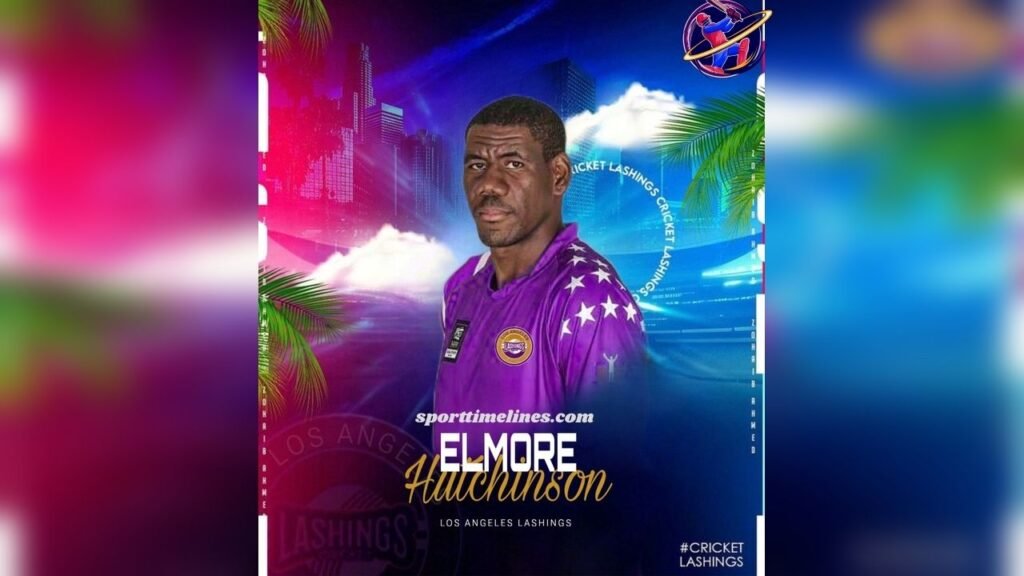
Elmore Hutchinson does not fit the typical profile of a modern international fast bowler. He was born in Jamaica, learned his cricket on Caribbean pitches, moved to Los Angeles in his twenties, and did not make his ODI debut for the United States until he was 37 years old. By the time most fast bowlers are winding down, he was just getting started on the biggest stage.
At 6 feet 6 inches, he is one of the tallest players to have represented the USA in recent years. His nickname, “Gentle Giant,” captures the contrast that defines him: a soft-spoken, quietly respected figure off the field who becomes an intimidating presence with ball in hand. This profile examines what his numbers actually say about his game, how his career developed, and why his journey matters for American cricket.
Player Profile
| Detail | Information |
|---|---|
| Full Name | Elmore Howard Hutchinson |
| Date of Birth | 11 August 1982 |
| Age | 44 (as of October 2026) |
| Height | 1.98 m (6 ft 6 in) |
| Batting Style | Right-handed |
| Bowling Style | Left-arm fast-medium |
| Role | Bowler |
| Nationality | American (Jamaican-born) |
| ODI Debut | 13 September 2019 vs PNG |
| T20I Debut | 15 March 2019 vs UAE |
| Jersey Number | 55 |
The profile data tells you the basics. The more interesting story is in the gap between “Jamaican-born” and “ODI debut in 2019. “Hutchinson spent nearly two decades playing club cricket in California before getting a sustained international opportunity. His late arrival on the international scene is not a footnote—it is central to understanding his career.
From Westmoreland to Southern California
Hutchinson started playing cricket at nine years old in Westmoreland Parish, Jamaica, representing Petersfield High School before joining his local parish of Hanover at 18. He played four years of parish cricket in Jamaica, developing the fundamentals that would later define his bowling: the left-arm angle, the bounce generated by his height, and a willingness to bowl long, honest spells.
The move to the United States came in 2004, when he settled in Southern California and began playing in the highly competitive Southern California Cricket Association. His first club was Pegasus Cricket Club, led by former Bangladesh national player Nazim Shirazi. Hutchinson took wickets by the bucket-load, and word began to spread that a future USA player was bowling in the SCCA.
Hutchinson’s decade of club cricket in California was not a detour from his career—it was his career. The SCCA gave him the volume of overs and responsibility that shaped him into a bowler capable of handling international pressure when the chance finally came.
How He Became a USA Cricketer
Hutchinson was first selected for the United States in 2011. His breakthrough performance came at the 2011/2012 ICC World Twenty20 Qualifier in the UAE, where he produced what he still considers his best all-round display: figures of 3/22 against Ireland and a top score of 29 batting at number nine. That performance demonstrated two things that would remain constants throughout his career: the ability to take wickets in pressure situations and a batting contribution that was far more than mere tail-end nuisance value.
What the Numbers Say About His Game
Hutchinson’s international record is modest in volume but revealing in character. Let us look at his career statistics across formats.
| Format | Matches | Wickets | Bowling Average | Economy | Best Bowling |
|---|---|---|---|---|---|
| ODI | 11 | 4 | 56.50 | 4.34 | 1/12 |
| T20I | 4 | 2 | 15.50 | 3.87 | 2/7 |
| List A | 31 | 30 | 25.40 | 4.07 | 5/42 |
| T20 (Domestic) | 17 | 12 | 25.50 | 7.28 | 3/22 |
The ODI numbers look unflattering at first glance. Four wickets in 11 matches at an average of 56.50 is not the return of a frontline wicket-taker. But the economy rate of 4.34 tells a different story. In an era when ODI run rates have climbed steadily, Hutchinson’s ability to bowl tight spells with the new ball and through the middle overs had real value even when wickets did not come.
A bowler with a high average and a low economy is doing a specific job: containing runs and building pressure from one end while attacking bowlers operate from the other. Hutchinson’s ODI role was rarely that of the strike bowler.
His T20I numbers are far more encouraging. An average of 15.50 and an economy of 3.87 across four matches, including best figures of 2/7, suggest that his skills translated more effectively to the shortest format. The T20I sample is too small to draw firm conclusions, but the early evidence points to a bowler who could have been more than a peripheral figure had he received more opportunities.
The Club and Domestic Record That Tells the Fuller Story
If the international numbers seem slight, the domestic record fills in the gaps. Hutchinson’s List A figures—30 wickets at 25.40 with a best of 5/42—demonstrate genuine wicket-taking ability over a larger sample. His domestic T20 record of 12 wickets at 25.50 with a best of 3/22 is similarly solid.
| Format | Runs | Average | Strike Rate | Highest Score |
|---|---|---|---|---|
| ODI | 142 | 23.66 | 99.30 | 49* |
| T20I | 16 | 16.00 | 200.00 | 16 |
| List A | 404 | 16.16 | 92.44 | 49* |
His batting deserves more attention than it typically receives. An ODI average of 23.66 with a strike rate of 99.30 is genuinely useful for a lower-order player. His highest score of 49 not out came in 2021, and he struck the ball at nearly a run a ball throughout his ODI career. Former USA coach Robin Singh occasionally used him as a pinch-hitter at number three in T20 tournaments because of his ability to clear the ropes. A bowler who can bat at number three in a T20 match is not a conventional tailender.
Career Timeline
| Year | Career Event |
|---|---|
| 1982 | Born in Westmoreland Parish, Jamaica |
| 2004 | Moves to Southern California |
| 2011 | First selected for USA national team |
| 2011/12 | 3/22 vs Ireland at ICC WT20 Qualifier |
| 2017 | Replaces Timroy Allen at Jamaica Tallawahs for CPL |
| 2018 | Drafted by Jamaica Tallawahs for CPL |
| 2019 | ODI debut vs PNG (13 September) |
| 2019 | T20I debut vs UAE (15 March) |
| 2021 | Last ODI vs Oman (20 September) |
| 2021 | Last T20I vs Bahamas (13 November) |
The timeline reveals the most important turning point: 2011, when he was first selected for the USA. Everything before that was preparation. Everything after was the result of two decades of club cricket finally being recognized.
Hutchinson was one of twelve players to sign a three-month central contract with USA Cricket, a landmark moment for the organization’s professionalization. The contract was modest in length and, as far as public information indicates, in value, but it represented formal recognition of his contribution.
The CPL Opportunity
Hutchinson’s selection for the Jamaica Tallawahs in the 2017 Caribbean Premier League was a significant moment for American cricket. He replaced Timroy Allen as the Tallawahs’ ICC Americas contract player, described as a “like-for-like replacement.” The following year, he was among four USA players drafted into CPL franchises, a rare instance of American-based cricketers earning recognition in a major T20 league.
For USA cricket to develop, its best players need exposure to higher standards of competition. Hutchinson’s CPL selection was proof that the pathway could work—even if the opportunities remained scarce.
What Makes Hutchinson Different
Hutchinson is not a bowler who relies on raw pace. At his height, he generates bounce naturally, and his left-arm angle creates an awkward trajectory for right-handed batters. ESPNcricinfo described him as “a gentle giant” off the field but “a menacing left-handed fast bowler” on it, noting that while not exceptionally quick, he produces “decent swing” and extracts “considerable bounce” from his frame.
His bowling is built on accuracy, subtle movement, and the uncomfortable bounce that only a 6ft 6in left-armer can create. He is not a strike bowler in the conventional sense. He is a pressure bowler—the kind who builds dots, forces mistakes, and makes the other end more effective.
Casual fans often measure bowlers by wickets alone. Hutchinson’s value was frequently in the overs that did not produce wickets: the tight spells that kept run rates down and allowed USA’s attacking bowlers to operate with greater freedom.
Strengths and Limitations
Strengths:
- Natural bounce and awkward angle for right-handers
- Disciplined economy rates across formats
- Useful lower-order batting with genuine power
- Experience and calmness in pressure situations
- Height that creates a distinctive visual and tactical challenge
Limitations:
- Limited international opportunities
- Wicket-taking output in ODIs below his domestic record
- Age at debut limited his peak years at the international level
- Small sample sizes make definitive assessment difficult
His international career was brief—11 ODIs and 4 T20Is between 2019 and 2021. The sample is too small to judge his ceiling, but large enough to see the shape of his game: economical, disciplined, and occasionally capable of match-changing contributions with the bat.
Contract and Salary Situation
Publicly available information about Hutchinson’s compensation is limited and should be treated with caution. Reports indicate he was among the USA cricketers on a three-month central contract, but exact salary figures have not been consistently disclosed. The Times of Now reported that official salary details for USA Cricket centrally contracted players have not been published, and listings for Hutchinson’s salary show “N/A”.
Any figure presented for his earnings would be speculative. What can be said with confidence is that his central contract was short-term and that USA Cricket’s payment structures at the time were not comparable to those of full-member nations.
Recent Form and Current Status
Hutchinson has not played international cricket since November 2021, when he appeared against Bahamas in a T20I. He has remained active in domestic and franchise cricket, including appearances in the National Cricket League and various T20 tournaments in the United States. As of October 2026, there is no indication of a return to the USA national side.
Hutchinson’s continued presence in American domestic cricket suggests he remains a competitive bowler at that level. Whether that translates into any future international involvement depends on selection priorities and his own availability.
The Legacy Question
Hutchinson’s international career will not be remembered for its statistics. Four ODI wickets and two T20I wickets do not tell a story of sustained excellence. What his career does represent is something arguably more important: proof that American cricket can produce and select players who have learned the game in the Caribbean and developed it in the United States.
He was part of a generation of USA players who bridged the gap between club cricket and international recognition. His late debut was not a failure of his ability—it was a reflection of how limited the opportunities were for American cricketers during his prime years.
Hutchinson’s career is a reminder that talent alone is not enough. Timing, opportunity, and institutional support determine whether a player’s abilities are ever fully seen. His numbers are modest; his significance is not.
What Comes Next
At 44, Hutchinson’s international career appears to be behind him. His future in the game is more likely to involve club and franchise cricket, mentorship, or some combination of both. What he leaves behind is a template: a player who developed his game in the USA’s domestic structure, earned a national call-up, and represented his adopted country with distinction when the chance finally arrived.
The next generation of USA cricketers will have earlier opportunities. Hutchinson’s career is part of the reason why.
FAQs
Q. How tall is Elmore Hutchinson?
Q. When did Elmore Hutchinson make his international debut?
Q. What are Elmore Hutchinson’s best bowling figures?
Q. Is Elmore Hutchinson still playing cricket?
Q. Where was Elmore Hutchinson born?
Q. How much does Elmore Hutchinson earn?
A. Publicly available information about Elmore Hutchinson’s earnings is limited. Reports indicate he was on a three-month central contract with USA Cricket, but exact salary figures have not been consistently disclosed. Official salary details for USA Cricket centrally contracted players have generally not been published.
Q. What is Elmore Hutchinson’s batting record?
Q. Did Elmore Hutchinson play in the Caribbean Premier League?
A. Yes. Hutchinson was selected by the Jamaica Tallawahs in the Caribbean Premier League, first as a replacement for Timroy Allen in 2017 and then as a drafted player in 2018. He was one of a small group of USA-based players to earn CPL opportunities.
Q. What makes Elmore Hutchinson unique as a cricketer?
A. Hutchinson’s combination of height, left-arm angle, and late international debut makes him unusual. He is a Jamaican-born American who developed his game in California club cricket, earned national selection in his late twenties, and made his international debut at 36. His career is a case study in patience and persistence.
Q. How does Elmore Hutchinson compare to other USA bowlers?
A. Hutchinson’s international record is modest compared to USA’s leading wicket-takers, but his economy rates were competitive. His domestic List A record of 30 wickets at 25.40 suggests genuine wicket-taking ability that was not fully reflected in his limited ODI opportunities. Comparisons are difficult given the small international sample.